For further information
on any news stories please contact Peter Swan at SBES. +44
1737 226622 or email peter.swan@sbes.co.uk
December 2005: Solvay Installs High-Tech
Loner Worker System...>>>
November 2005: Applied Biosystems Ensures
Health and Safety...>>>
October
2005: SBES Announces Deal to Supply Safety Systems at Lakeland...>>>
July 2005: Battery Manufacturer Boosts
Health & Safety...>>>
June 2005: Red Bull Racing Takes Pole Position
on Safety...>>>
June 2005: Steely Determination to Safeguard
Workers with SBES LifeSaver...>>>
April 2005: World first for SBES at Safety & Health
Expo 2005>>>
April 2005: SBES LifeSaver Installed in
International Technology Centre for BP...>>>
April 2005: Government Pledges to Get
Tough on Bosses ...>>>
February
2005: World first intrinsically safe Ex-rated LifeSaver...>>>
 December 2006 December 2006
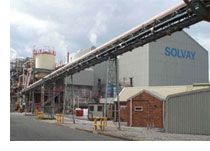
SOLVAY SPECIALITY CHEMICALS LTD, part of the global chemical
and pharmaceutical giant Solvay Group, has installed an SBES
LifeSaver system at one of its UK sites at Northwich, Cheshire.
The works at Northwich is home to the production of Coated
Precipitated Calcium Carbonate, a performance bulk filler,
and the workforce at this location work extended hours, often
isolated from colleagues and over a large site area.
Ged Cassidy, production manager at the site, explains the
necessity for the new state of the art system:
“We operate a 24-hour, seven-days-a-week
production plant, and we required a system with the ability
to raise the alarm if an operator needed assistance, especially
on weekends and nights when there is a limited number of
people on the site.
“The operators often work remotely
for extended periods of time, over a large-area, three-storey
plant, and we needed a system that could automatically
summon help quickly and accurately in the event of an emergency
situation. The SBES system is now an integral part of our
emergency procedures.”
The SBES LifeSaver system at Solvay covers eight zones,
which allows workers carrying the personal alarm transmitters
to move anywhere within the premises and be within range.
The small personal alarm transmitter can be activated either
manually or if tilted beyond a tilt and time limit, and as
well as setting off a loud alarm at the central panel, it
is set with Auto Dialler to call preset phone numbers when
activated, and to continue to call down the list of numbers
until a message is confirmed received.
Peter Swan, managing director of
SBES, adds: “The
SBES LifeSaver is ideal for installation in factory environments
such as this one. It is a completely flexible system, with
the customer determining the scope of the functionality within
a site. A network of help points and transmitters can be
hardwired into the customer’s site infrastructure and
forms a roaming system so workers can move from area to area
and still be supported by the full safety system, with transmitters
able to be activated in a 300m range.”
LifeSaver’s highly visible
Help Points are easily activated by anyone in trouble and
are offered in break-glass or push-button versions, a ceiling-mounted
pull-cord style and a splash-proof model. Typically, a
central control panel lies at the heart of the system,
which can be situated in any operational control area such
as a security office or reception area and these are capable
of a visual and audible alarm. Upon activation of a Help
Point or Lone Worker transmitter an alarm signal is sent
to the Control Panel and this immediately shows the controller
the exact location of the incident by indicating which
Help Point or Lone Worker tilt alarm has been triggered.
There is also the option of having SBES LifeSaver automatically
page relevant appointed safety personnel informing them of
the incident location and setting up SMS alert text messages
to mobile phones and networked PC alert messages. Alarm alerting
options offered with the SBES LifeSaver include local area
paging, auto-dialler to telephone numbers and beacon sounders
or a combination of any of these.
ENDS
back to top
 November
2005 November
2005
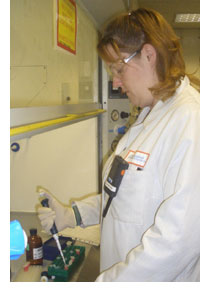
APPLIED BIOSYSTEMS, The global life sciences company, has
invested in some state-of-the-art lone worker safety systems
for its bulk chemical manufacturing facilities in Warrington,
Cheshire.
The seven MICRO LifeSaver systems
from SBES have been installed at Applied Biosystems’ two
Warrington facilities, where scientists and manufacturing
workers work in large laboratories and are often isolated
from colleagues or working outside office hours.
Bobbie Howarth, Applied Biosystems’ Environmental
Health and Safety Advisor, explains why she chose to specify
the SBES LifeSaver systems:
“There are many lone worker
alarms on the market which rely on radio frequencies, but
we have areas on our premises which have black spots making
most alarms inadequate for use. Further to the risk assessment
the SBES LifeSaver system met all the criteria: each unit
features auto-dialling to four preset phone numbers, and
can be activated either manually or when tilted beyond
a set tilt and time limit. They are also simple to use
for our employees.”
“Up to 14 workers can use the
system at any one time and it has been received with unanimous
approval not least for the peace of mind it has given our
staff.”
The MICRO SBES Lifesaver system has
been designed for smaller sites or companies. Each MICRO
SBES LifeSaver accommodates two ‘Lone Worker’ wire-free alarm transmitters.
Worn in belt-clip form, the wireless transmitter can be triggered
manually or automatically and when activated the transmitter
sends a signal indicating the wearer’s location.
Alarm alert options offered with the SBES LifeSaver MICRO
systems include local area paging, auto-dialler to four or
ten telephone numbers, SMS texts and beacon sounders or a
combination of any of these. Each system is supplied complete
including installation, training and documentation. Optional
pagers and beacon sounders can be added at very low cost
and an optional rechargeable battery back-up unit will operate
the system for at least eight hours in the event of power
failure.
ENDS
back to top
October 2005
SBES has completed
a deal to supply and install its LifeSaver lone worker
safety alarm system at the Kendal distribution centre of
Lakeland Ltd, the nationwide homewares retail and mail
order company.
Lakeland’s distribution hub
in Kendal is a vast site comprising high-bay warehousing,
and often stock picking operatives, fork lift truck drivers
and maintenance staff work outside office hours and isolated
from colleagues.
Marc Harrison, Lakeland’s facilities
manager, explains the need for a lone worker safety system:
“Stock picking involves working
at heights and in hidden areas of an enormous warehouse,
often into the night when there are fewer other staff around.
Also our maintenance staff work with some heavy machinery
and are even required to access the roof regularly. It
is therefore important that we supply them with the most
high tech safety equipment, and an alarm system that notifies
security if they are in trouble is an important investment.”
SBES has supplied a LifeSaver system with the SBES lone
worker transmitters covering the whole warehouse area including
stairs and roofs. Workers carry a small personal alarm transmitter,
which can be activated either manually or if tilted beyond
a tilt and time limit.
About the system
The SBES LifeSaver is a completely flexible system, with
the customer determining the scope of the functionality within
a site. A network of SBES receiver modules are hardwired
into the site infrastructure and forms a roaming system so
workers can move from area to area and still be supported
by the full safety system.
Highly visible Help Points can be added to the system and
are easily activated by anyone in trouble and are offered
in break-glass or push-button versions, a ceiling-mounted
pull-cord style and a splash-proof model. Typically, a central
control panel lies at the heart of the system, which can
be situated in any operational control area such as a security
office or reception area and these are capable of a visual
and audible alarm. Upon activation of a Help Point or Lone
Worker transmitter an alarm signal is sent to the Control
Panel and this immediately shows the controller the exact
location of the incident by indicating which Help Point or
Lone Worker tilt alarm has been triggered with its location.
There is also the option of having SBES LifeSaver automatically
page relevant appointed safety personnel informing them of
the incident location and setting up SMS alert text messages
to mobile phones and networked PC alert messages. Alarm alerting
options offered with the SBES LifeSaver include local area
paging, auto-dialler to telephone numbers and beacon sounders
or a combination of any of these.
ENDS
back to top
 July 2005 July 2005
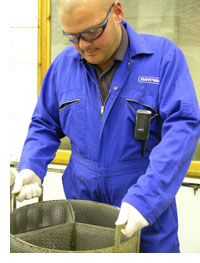
Rayovac Europe Ltd, the world’s
leading manufacturer of hearing aid batteries, has chosen a MINI SBES LifeSaver
system to protect workers in a coating operation at its manufacturing
plant in Washington, Tyne & Wear.
The plant employs 150 people in the
production of ‘Zinc
Air’ hearing aid batteries. This works through a unique
construction that utilizes oxygen from outside the battery
to react with the zinc producing energy which powers the
hearing aid.
A safety review by The Health & Safety
Committee and Human Resources team at Rayovac identified
a potential risk for an operator working separately from
his supervisor and co-workers in a process using solvents.
The review concluded that in the event of him falling ill
or suffering an accident, the other workers would not be
immediately aware of his condition.
The MINI SBES Lifesaver system has
been designed for smaller sites or companies and consists
of a personal transmitter worn by the employee and a control
panel. The transmitter can be triggered manually or by
a tilt sensor, and sends a signal via the control panel
to the worker’s supervisor
through his personal pager. The company also specified a
second transmitter for use in the site’s warehouse,
which operates through the same control panel.
Michael Oliver, Plant Engineer at
Rayovac, explained: “SBES
LifeSaver met all our requirements for a safety monitoring
system that was flexible, reliable and cost effective.”
The SBES LifeSaver MINI accommodates
up to four ‘Lone
Worker’ wire-free alarm transmitters, up to eight installed ‘Help
Points’, or a combination of these as required.
Worn in belt-clip form, the wireless
transmitter, can be triggered manually or automatically
and when activated the transmitter sends a signal indicating
the wearer’s
identity and location.
The highly visible Help Points are easily activated by anyone
in trouble and use wire-free transmission with a 300m range
for easy installation and relocation. They are offered in
break-glass or push-button versions, a ceiling-mounted pull-cord
style and a splash-proof model.
Alarm alert options offered with the SBES LifeSaver MINI
and MICRO systems include local area paging, auto-dialler
to four telephone numbers and beacon sounders or a combination
of any of these. A battery back-up facility is also available.
ENDS
back to top
 June
2005 June
2005
Red Bull Racing, the Formula One motor sports company, has
chosen the SBES LifeSaver lone worker protection system to
safeguard staff at its technical site and offices in Milton
Keynes.
The SBES LifeSaver system was originally
installed in one of the site’s two buildings and
comprised one central control panel situated in the main
reception area and four wireless personal alarms.
Following a successful trial, Red Bull Racing, decided to
double coverage of the SBES LifeSaver to include the other
building and specified three more personal alarms.
The personal transmitters are worn clipped onto the belt
or overalls and are picked up by the staff member when he
or she begins a period working alone or isolated from colleagues.
The units are designed to summon immediate aid in the event
of illness or injury either through manual activation or
via a tilt sensor that triggers if the wearer moves more
than 45 degrees from the upright position. A programmed time
delay and audible and vibration alarm prevents accidental
activation.
Following a risk assessment it was decided that key personnel
at the site, which employs about 360 people in total, would
benefit from an increase in safety monitoring because many
day-to-day tasks involve periods of working alone or out
of hours.
The company decided to permanently allocate four of the
personal alarms to workers employed in machine processes
in the fabrication area and the test area, one alarm was
located in the refueling area and another covers a fourth
machine area some distance from other workers where it might
be some minutes before an injured operator was discovered.
Ian Prior, Manufacturing Systems
and Safety Manager for Red Bull Racing, a subsidiary of
the energy drinks brand, commented, “I saw the system
at the Safety and Health Expo and thought that it seemed
to meet our needs perfectly. The Red Bull brand is all
about living life to the full and helping people fulfill
their goals, and that clearly embraces protecting the welfare
of employees.
“The company takes its role as an employer very seriously
and sees no conflict between taking safety seriously and
having fun. It also makes good business sense; motor racing
is intensely competitive and we can’t compete effectively
if our people are off sick or missing due to accidents.”
ENDS
back to top
 June 2005 June 2005
When the UK’s leading independent steel fabricator
William Hare Ltd carried out a safety assessment on workers
operating cutting and drilling equipment, the assessors identified
that the location of the equipment in booths separating them
from other workers could pose a risk and delay first aid
by vital seconds in the event of an accident or fall.
However, the company found the ideal
solution in the SBES LifeSaver MICRO system which equips
each of the machine operators with a personal wireless
transmitter that automatically activates an audio and visual
alarm system if the user tilts more than 45†. It
is therefore capable of summoning help in the first vital
seconds of a fall or the user becoming unconscious. The
system can also be programmed to summon help via phone
messages or pagers.
The SBES LifeSaver MICRO system represents
an advanced refinement of safety systems that are given
total priority at the California Works in Bury, Lancashire,
where the company’s outstanding
safety regime has previously earned a gold award from RoSPA.
General Manager of the works Bob
McLellan explains: “The
board of directors takes safety very seriously and insists
on a policy of zero compromise in our working practices;
regardless of cost or other factors safety always comes first.
In fact our CEO personally visits the workshops on a regular
basis to ensure that the safety procedures are being followed.
“Our machine operators are not ‘lone workers’ in
the true sense of the term, and our operating procedures
ensure they are in contact with their colleagues every few
minutes, but the booths where they work make it impossible
to maintain constant visual contact and we wanted to ensure
that in the event of an incident or injury, immediate assistance
could be summoned. The SBES LifeSaver system does just that – activating
an audio and visual alarm – and we’ve proved
its effectiveness with regular tests.”
William Hare is the UK's premier
independent structural steelwork contractor serving the
UK and overseas markets. The company operates in all the
major structural market sectors including oil & gas,
LNG, petrochemical, pharmaceuticals, power, nuclear, civil,
bridgework, airport, infrastructure, commercial and retail
developments.
ENDS
back to top
April 2005
The proposed change to the law on
corporate manslaughter has put health and safety high on
the boardroom agenda and gives bosses an extra reason to
visit stand C73 in Hall 9 at the Health & Safety Expo
2005, where SBES Ltd will be showcasing its range of lone
worker safety systems.
The SBES LifeSaver lone worker protection
system is designed to summon immediate aid in the event
of injury and illness. The system is hardwired into a building’s
infrastructure and includes help points, control panel
and wireless personal transmitters that are worn in belt-clip
form and are activated either manually by the user or automatically
when triggered by a tilt sensor.
SBES has now achieved a world first in launching a personal
emergency transmitter unit that is Ex-rated for use in explosive
atmospheres and hazardous locations in industries including
oil and gas, chemicals manufacturing and food production.
The new Ex-rated LifeSaver equipment will be on show alongside
the recently launched MINI and MICRO LifeSaver systems that
are designed to offer the same level of protection for smaller
numbers of workers on fixed sites or single worker sites.
The SBES LifeSaver MINI system accommodates
up to four ‘Lone
Worker’ wire-free alarm transmitters, up to eight installed ‘Help
Points’, or a combination of these. It provides a simple
and fail-safe means for help to be summoned rapidly in the
event of a problem anywhere around the site.
The new SBES LifeSaver Micro system
introduces the same high level of personal protection to
one-man operations. It incorporates a tilt unit to send
an automatic alarm signal via an auto-dialler to four telephone
numbers, pager or beacon sounder, and the price from around £1000
includes installation, training and documentation.
For more information on the Ex-rated intrinsically safe
SBES LifeSaver unit or the range of other lone worker protection
systems developed by SBES call 01737 226622.
ENDS
back to top
April 2005.
World leading lubricant specialist,
BP, has chosen SBES’ Ex-rated
lone worker safety alarm system for installation at its Technology
Centre.
The Technology Centre is the main source of development
for the world wide BP lubricant business, supporting the
most comprehensive range of lubricants and related products,
with a portfolio that includes Castrol, BP, Duckhams, Aral
and Veedol. The group also supplies lubricant and technical
support to motorsport teams such as BMW Williams F1.
There are over 200 employees at the site in Whitchurch Hill,
Pangbourne, and they frequently need to work alone in laboratories,
testing bays, performing general maintenance and service
work around the site or taking fuel deliveries. Much of this
work takes place outside normal working hours, but the SBES
LifeSaver system ensures that in the event of an accident
or health problem they can get instant assistance on a 24/7
basis.
The BP site occupies 21 buildings
over 35 acres and it required an advanced ‘roaming’ alarm
system. BP needed a system which was intrinsically safe
and Ex-rated so that it could be used across the whole
site, and which would be safe in areas where potentially
dangerous and volatile materials are used or stored, such
as engine test areas and laboratories. The SBES LifeSaver
is the only Ex-rated safety system, and offered the flexibility
and functionality required by BP. Unlike other safety systems,
the SBES Ex LifeSaver identifies the specific location
where assistance is needed, not just the building, and
the workers equipped with Ex-rated personal transmitters
have the flexibility to move from building to building
and still be protected.
SBES has supplied 35 Ex-rated personal
alarm units, and the number of alarms available to personnel
can be expanded for the future, virtually without limit.
The company also supplied a central control panel installed
in the site’s
reception area, which is manned 24/7. Each relay station
is hardwired to the system while the personal units are wire
free and worn in belt clip form by the individual. The personal
alarms can be activated manually or are tilt-activated in
case of emergency. A manual delay mechanism enables the user
to access difficult areas, which may mean lying down for
a few minutes, without triggering the alarm.
SBES worked closely with BP’s
own maintenance staff on installation of the system after
BP performed a risk assessment survey to find out which
areas needed protection. As a result of the survey all
laboratories and engine testing areas were allocated personal
alarms, which are positioned on wall brackets at the entrance
to each room to be used by lone workers for the duration
of his or her shift.
Archie Cuthbert, Health and Safety
Manager at BP’s
Pangbourne site explains: “We’ve been testing
the system and it is everything SBES said it would be.
The health, safety and security of everyone who works for
us is critical to the success of our business and we have
developed a zero tolerance policy: no accidents, no harm
to people, and no damage to the environment.
“BP looked at a range of systems
before choosing the SBES Ex-LifeSaver and we found that
this one gave us the benefit of being able to identify
exactly where someone is so we can react to an emergency
quickly and effectively. In a serious incident saving even
seconds can be vital in saving lives, and the SBES LifeSaver
has significantly enhanced the protection for our workforce.”
SBES Ltd, Managing Director, Peter
Swan commenting on the contract, said: “BP has won
awards for its stringent safety policies and active HSE
culture, and places the highest priority on health and
safety issues, so it is extremely rewarding that the SBES
LifeSaver system we have worked so hard to develop has
been selected.”
ENDS
back to top
April 2005.
Company bosses who neglect their responsibilities to lone
workers by failing to provide them with adequate personal
safety monitoring could face prison if legislators have their
way, warns safety specialist SBES Ltd.
In addition to the Government’s pledge to get tough
on corporate manslaughter a private member’s bill currently
going through Parliament wants individual board directors
to be made responsible for health & safety, and take
the personal consequences if they fail their workers.
Employers already have to comply
with various statutes (the Health and Safety at Work Act
1974, the Workplace (Health Safety and Welfare) Regulations
1992 and the Management of Health and Safety at Work Regulations
1999) and according to the Health and Safety Executive
the employer “has
a duty to assess and manage risks by taking steps to avoid
or control where necessary.” The government’s
position on the subject is already clear with regards to
worker safety but in the future it will be easier to prosecute
employers who do not provide suitable safety systems on a
day to day basis and in case of emergencies.
Lone workers are potentially at greatest
risk but could be protected from death or debilitating
injury by the investment of a few hundred pounds per worker
according to SBES which has pioneered the advanced SBES
LifeSaver system that provides a safety alert within seconds
of a worker’s fall or
collapse. Those seconds can make the difference between life
and death says SBES MD Peter Swan.
He explains: “Current legislative
requirements state that in order to fulfill their duty
of care to employees, employers must assess the risk all
workers are exposed to. They must take measures to mitigate
these risks as well as put in place emergency procedures.
“The new legislative moves
may place the responsibility for safety with individuals,
and that could mean heavy fines or prison for company bosses.”
Lone or solitary working has become increasingly common in
the past few years with the advent of increasingly interactive
communication technology and increased mobility.
Lone workers are classed as employees who work without direct
supervision on or off site, either some or all of the time.
Lone workers include people traveling for work, people working
on fixed sites on their own, people working outside normal
hours and people working off site performing contract work.
Dangerous work is often performed
by lone workers, for example in electrical roadside repair,
in computer and service rooms of buildings, in factories
and a wide range of day-to-day work, and yet it is an employer’s
duty to ensure that employees who work alone are not subject
to any residual risk compared to ordinary workers.
The current level of worker deaths per year illustrates that
some employees are unaware of the issues surrounding worker
protection, says Peter Swan.
“Although many employers are well aware of their duty
of care to protect people on site, it seems they are less
aware of their responsibility to solitary or lone workers
and could be failing in their duty of care,” he said.
“Some employees suppose there
is a dichotomy between protecting workers and running a
successful business and hold that cost is a barrier to
offering adequate protection, yet if current legislation
goes through it will be much easier to prosecute employees
for negligence resulting in accident or death and bosses
could end up paying out much more in the long run.”
Some companies provide workers with mobile phones for use
in the event of an accident of emergency and to mitigate
risks to employees but according to Peter Swan, this may
still not go far enough in providing workers with adequate
personal protective equipment (ppe).
“This is not adequate protection if it turns out that
the worker is unable to get a signal or cannot get through
or is not in a position to be able to make a call,” he
said. “Some companies try to mitigate the risks to
lone workers by sending workers out in pairs, even if the
job could easily be performed by one person alone. This means
that the company is paying two people to do one job, yet
it still does not mean adequate protection in an emergency.” Peter
Swan realised that there was a dearth of companies using
technology in such a way as to provide personal emergency
response that was fast and effective whilst working on a
risk assessment with the British Safety Council at a prestigious
London financial institution. He found that the procedures
in case of sudden illness or injury were inefficient and
costly.
He then had the idea to develop a
bespoke system that automatically alerts a worker’s
line manager or colleagues in the event of an emergency
and uses satellite technology to pinpoint the exact location
and went on to invent an integrated range of products fulfilling
every area of personal emergency response, at any time
or location and even on the move
There are four distinct products
covering all applications. The SBES ‘LifeSaver’ system is a bespoke product
which protects staff or customers in fixed sites. The SBES ‘Protector’ system
is a lightweight portable system for employees who move from
one site to another. The SBES ‘Tracer’ is for
vehicle based staff and provides lone worker protection,
in or out of the vehicle, as well as a vehicle tracking system.
The SBES ‘Responder’ is a personal alarm system
carried in a bag for individuals undertaking potentially
hazardous activities whether in the work place or pursuing
a leisure activity.
ENDS
back to top
February 2005.
Lone worker protection specialist SBES Ltd has achieved
a world first in launching a personal emergency transmitter
unit that is intrinsically safe and Ex rated for use in explosive
atmospheres.
The Ex-rated wireless unit is part of the LifeSaver system
and enables workers operating in hazardous locations in industries
including oil and gas, chemicals manufacturing and food production,
to enjoy the full protection of the system that summons immediate
aid in the event of injury or illness. It can also operate
as part of other self-contained SBES systems for protecting
workers travelling to different Ex-rated locations and providing
service support.
The SBES lone worker wire-free alarm transmitters are worn
in belt-clip form and are activated either manually by the
user or automatically when triggered by a tilt sensor if
the unit moves from a vertical position because the wearer
has fallen or been rendered unconscious. Time-lapse operation
and a reset facility prevent the unit being activated accidentally.
From June 2006 all electrical and mechanical equipment installed
in potentially explosive atmospheres in Europe must be ATEX
compliant (under the ATEX directive 94/9/EC) and must bear
the Ex mark and CE marking. Manufacturers must design and
test components to prevent or minimise the risk of explosion
and must consider every possible electrical or non-electrical
source of ignition.
SBES chief executive officer Peter
Swan explains that gaining an Ex rating for the personal
transmitter unit involved innovative changes to the device
to meet the stringent testing and certification requirements.
He says: “We had identified a demand
for an intrinsically safe unit through analysis of the market
and discussions with our clients in key industries, where
operating in hazardous environments and potentially explosive
atmospheres is a fact of life. The new Ex personal LifeSaver
unit extends protection to those workers who are potentially
at greatest risk, and enables employers to fulfil their duty
of care obligations.”
The SBES LifeSaver system consists
of a central control panel and a range of activation products.
Highly visible ‘Help
Points’ in different zones can be activated by workers
in trouble using emergency pull cords, and wall-mounted pushbutton
or ‘break-glass’ units which are used in addition
to the Lone Worker wire-free alarm transmitters.
In the fully integrated system, alarm activation instantly
sends a visual and audible signal of the incident location
to the control panel and simultaneously pages first-aiders
with the information. The system is also capable of sending
SMS text messages to mobile phones and activating networked
PC alert message.
There is no limit to the number of Help Points and Lone
Workers and the system allows for programming an unlimited
number of zones. A rechargeable battery back-up keeps the
system fully operational for a minimum of 8 hours in the
event of a power failure.
For more information on the Ex-rated intrinsically safe
LifeSaver unit or the range of other lone worker protection
systems developed by SBES call 01737 226622.
ENDS
back to top |