For further information
on any news stories please contact Peter Swan at SBES. +44
1737 226622 or email peter.swan@sbes.co.uk
Automatic Alarms for Site-Based Lone Workers ...>>>
SBES Supplies Lone Worker Solution to CCLRC ...>>>
PERSONAL alarm systems that allow lone workers to call for help if they are attacked while out and about are widely issued by employers with field staff now. But what if the risks facing your lone employees are more local - working at height on your premises, or with hazardous vapours in confined spaces, where they might need help but lose consciousness before they can hit a panic button?
This is where automatic alarms, also known as “man-down” alarms, come in. The systems are already popular in high-hazard industries such as petrochemicals, where lone workers could be at risk while cleaning tanks, but they are finding new uses.
Though automatic alarm units are still likely to have a panic button or cord that the operator can use if they are in trouble and still conscious, they will have something extra. The most common automatic trigger is a tilt switch. If the unit attached to the worker’s body moves beyond 45 degrees from the vertical, it will start an audible countdown, commonly of 15 seconds, to allow the wearer to reset the unit if it’s been triggered inadvertently. After that, it will send out an alarm message to a control point.
In situations such as confined spaces, or combined with fall-arrest equipment where a worker could be trapped upright, a tilt alarm is of little use. In these cases, units can carry motion sensors, where the countdown starts a preset time after the sensor stops detecting movement.
Though the focus in providing automatically activated alarms is usually on the nature of the work, they can also help employers discharge their duty of care where the risk is associated with, or increased by, an employee’s medical condition. Workers with epilepsy could be issued with tilt-activated units when working alone and diabetics who have any history of severe hypoglycaemic attacks could also benefit. Some employers offer motion sensor alarms to diabetes sufferers in white-collar jobs who might be working alone at computers for long spells. If the sensor is set to a high enough level of sensitivity in this sort of situation, just the motion of typing will prevent the alarm going off.
Back at base
You can issue workers with the highest specification alarm on the market, but you still haven’t begun to discharge your duty of care if they are not ensured of a fast response when it goes off.
The alarm signal is often routed to a terminal at a reception desk, facilities office or security station, or any other permanently staffed location where software will show on a site map the identity and location of any worker who triggers a call. But many systems can be set to sound radio pagers or send email, SMS messages or recorded phone messages to nominated individuals, perhaps keyholders, and/or the emergency services. These latter options are especially useful to protect night security staff or lone workers out of hours.
Systems are often based on satellite tracking technology. These are fine outside buildings but will not pinpoint a worker’s level in a multi-storey building, so should be combined with other identification technology for indoor use.
Radio frequency (RF) based systems can send an alarm signal up to 1km in open space, but most materials, including window glass, will shorten their effective distance. Metal floor pans and ceiling grids in buildings present particular problems, but any obstacle can be overcome by higher-powered transmitters and extra relay stations to pass the signal beyond any blocking material. The RF on any alarm needs to be specified so that it doesn’t interfere with other radio devices on site, such as wireless IT local area networks.
After choosing an automatic lone-worker alarm system, you need check that whoever installs it is competent to make sure it won’t come up against any of these problems and that the units transmit properly from any part of the site lone workers might reach. It’s also worth asking any supplier you shortlist about their after-sales service and technical support and getting references from other companies using their system.
Reproduced from Health and Safety at Work Magazine – to read the the original article in pdf form click here – to find out more about Health and Safety at Work go to www.healthandsafetyprofessional.co.uk
- Ends -
back to top
SBES, the lone worker protection specialist,
has just completed the installation of its LifeSaver lone
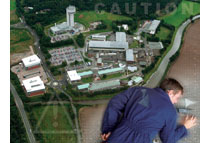
worker alarm system at the Synchrotron Radiation Source (SRS)
building at Daresbury Laboratory in Cheshire near Warrington.
The site is operated by the Council for the Central Laboratory
of the Research Councils (CCLRC) and is a World class facility
that supports the research community by providing access
to advanced facilities and extensive scientific and technical
expertise.
According to Andy Goulden, an engineer
at Daresbury Laboratory, this particular application was
unusual as there were two distinct types of lone workers
on the site that needed protection. Firstly, there were
CCLRC staff who might be working alone on a shift pattern
across a 24/7 period. Secondly, there were site ‘users’,
members of the research community that come to the building
in order to use the SRS.
With 500 staff in total, combined
with users moving around the building the potential for
a lone worker incident was high. Indeed the site had experienced
an incident where a worker had an accident, but was mercifully
able to raise an alarm. It was this incident that lead
CCLRC to specify an ‘off-the-shelf’ lone worker
solution. However, once in use, the deficiencies of this
solution were exposed and Andy and his colleagues began
to look for a more robust solution.
The ‘off the shelf’ solution, while raising
an alarm, did not give an indication of where the incident
had occurred. Because of the large size of the building this
presented a big problem. As Andy Goulden says, “In
order to get the freedom of movement for people, we needed
a system that gave us a much better indication of where people
were in trouble.”
Having found and been impressed with
the virtual demonstration of the LifeSaver system on SBES’ website, www.sbes.co.uk,
the company was invited to take part in a competitive tender
and came out on top in a decision that took into consideration
technical merit, health and safety procedures, documentation
and price.
The LifeSaver system that has been
installed at CCLRC is a modular system with the capacity
to be expanded. The base station for the system is located
in the building’s
reception which is manned 24hrs a day. Presently SBES has
supplied 25 of its lone worker alarm units and the system
has been tested to provide coverage in all the required locations.
If an alarm is activated then the security staff ‘accept’ the
alarm and organise a search. Due to the information supplied
by the LifeSaver base station the staff are directed to the
area where the alarm was triggered.
In terms of training, Andy received
training from SBES in how to operate the system and how
to wear and store the alarm units. He now trains the personnel
that need to use the lone worker protection system and
he says that it only takes around half an hour. With such
a large site to cover CCLRC are looking to expand the system
to cover all of the buildings and have no qualms about
keeping faith with SBES. As Andy Goulden says, “SBES
is a very efficient company with great technical expertise.
Their customer service and documentation are absolutely
first class too.”
- Ends -
back to top |








 SBES
SUPPLIES LONE WORKER SOLUTION TO CCLRC
SBES
SUPPLIES LONE WORKER SOLUTION TO CCLRC